
Official Knox Crime Sources
Start where the records live. The Knox County Sheriff's Office posts a 24 Hours In Custody page covering recent public bookings, plus a separate Inmate Population page for people held right now. Those are two different questions. The 24-hour label describes a rolling agency window, so treat it as a snapshot of recent activity rather than a guarantee about timing. The population view is current custody only, not an archive of past arrests.
Once someone is booked, the case moves to court. The Knox County Criminal Court Clerk holds the criminal and general-sessions dockets that show what actually happened next. A KCSO listing with a bond amount, court date, or division is a pointer toward a court file. It does not tell you whether bond was paid, whether the person walked free, or how the case resolved. For any question about a disposition, the Clerk's records are the place to look.
Knox Crime News Sources
Local news earns its keep on the big cases. A dated account of a major investigation gives you something a booking list never will. So does a quote from an agency or a court filing. What news does not do is serve as a daily county arrest feed. Knoxville television stations and newspapers cover Knox County alongside East Tennessee and state stories. Farragut adds a weekly layer of its own. Its local paper runs selected KCSO police-report items. Wherever a claim comes from, keep the source, the publication date, and the agency or court attribution attached to it.
Newsrooms choose what to print. A story might cover an investigation touching dozens of people, a single high-interest arrest, or a court development that broke months after the booking. An outlet running one agency photo has not somehow acquired every booking photograph in the county. When precision matters, match the story against the sheriff's record and the court docket.
Knox Crime News Freshness
Dates matter as much as headlines. The KCSO recent-custody page is a live, rolling view, so note the time you checked it. The inmate population page shows current custody and nothing more. Neither one is a historical archive. Someone released from jail simply drops off the current roster, and KCSO does not publish a retention schedule saying how long old booking entries or photographs stay online.
Publisher-run sites work on their own clocks. RecentlyBooked describes its county view as covering 30 days. Arrests.org organizes by dated county pages, while BustedNewspaper and Mugshots.com keep historical or rolling indexes of their own. None of that reflects the sheriff's actual retention practices. A local news story should simply be read as a selected report with a publication date attached.
For an older account, work the chain. Compare it against the current KCSO view, then search the Criminal Court Clerk's records and ask KCSO Support Services for the right record. No source promises that a released person's image remains online anywhere.
Knox Crime News Outlets
The outlet table below puts things in order of trust. Official records come first. They establish the custody or court file that matters. Media outlets follow, adding narrative and context. Publisher-run indexes sit last. They are not official, they can be stale or thin, and they should never stand in for a county roster.
| Outlet | Coverage and use | Photo or record caution |
|---|---|---|
| KCSO 24 Hours In Custody | Official recent public custody window. | Check the agency page and its time. It is not a long-term archive. |
| KCSO Inmate Population | Official current-custody roster. | Absence does not prove no arrest, and presence does not prove guilt. |
| Criminal Court Clerk | Official criminal and general-sessions court records and dockets. | Use for disposition, not as a current-custody page. |
| Farragut Press | Recurring selected KCSO police-report items around Farragut. | Local narrative coverage, not a full roster and not a consistent photo source. |
| WVLT, WBIR, and Knox News | Event-driven regional crime and court reporting. | Editorial selections may use agency or court images. Verify the date and source. |
Knox Court News Context
Reporters sometimes build a story out of court files and KCSO data. That can surface case history, warrant references, or details a short custody listing never shows. Remember it is still an editorial product. A story might even reuse an older agency photograph. Read it as context for finding the case, not as a replacement for checking current custody or the live court docket.
The division of labor is simple. KCSO shows custody events and the current population. The Clerk shows court dates and the disposition, which is the legal outcome. That outcome might be a dismissal, nolle prosequi, a not-guilty finding, diversion, a conviction, or something else. A bond figure and a court date are leads, not answers.
Farragut KCSO Report Coverage
For the Farragut area, the Farragut Press stands out as the strongest local newspaper layer. Its recurring KCSO police-report feature, with examples from June 2026 and August 2026, can include incident dates, narratives, citations, and arrests. Treat it as community news, though. It is not a jail roster, and its photographs run inconsistently.
One reason these stories point back to the county: Farragut has no municipal police department, so KCSO provides law enforcement there. A Farragut-area case often lands in county custody systems for that reason. For more on city-specific agencies and records, see Farragut Busted Mugshots. Keep in mind that a publisher's city label is its own way of sorting records, not proof of where an arrest actually happened.
Photos in Knox Crime News
A news photo and a booking record come from two different worlds. WVLT builds its crime stories from KCSO releases, court filings, and TBI material. For a major case it may run an image credited to the agency, JIMS, KCSO, or TBI. Those pictures ride along with the story. They are not a daily feed of new bookings. The agency's own page updates on its own clock, and an article can stay online long after release or after a case moves ahead.
WVLT's Crime section appears below as a sample of event-driven regional reporting. Read it alongside the publication date, the story's attribution, and the official custody or court source, not as a photo gallery.
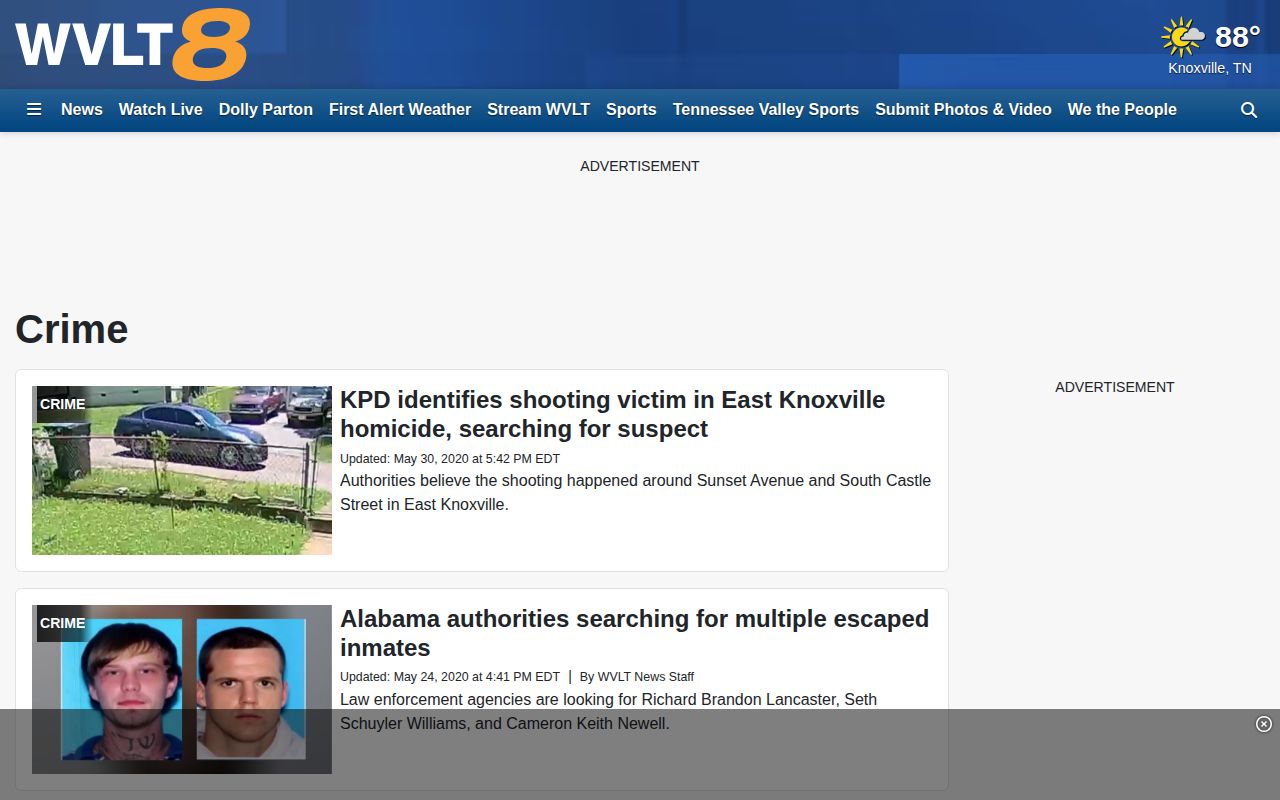
What you see there is a news category, not a record system. Its real value is context. Want current custody? That question belongs to KCSO. A later case outcome belongs with the Clerk.
From News to Knox Records
Treat a news item as a lead, never an endpoint. Before opening another record, pull together the story date, the full name as published, the reported event date, the named agency, and any court reference. Two people can share one name. Never merge them on that basis alone. When the fields exist, KCSO's IDN, document type, booking or served date, charge and bond fields, and court information help keep separate events separate.
Follow this order to move from an article toward a firmer record:
- Read the story's date and note whether it cites KCSO, a court filing, TBI, or another source.
- Check KCSO's current and recent views through the county booking and roster sources, taking note of the view and time checked.
- Compare the exact name with available date of birth or IDN, document type, booking date, charge, and bond. Do not make a name-only match.
- Search the Criminal Court Clerk for the court event and disposition. A listed court date is not a result.
- For a released or older record, ask KCSO Support Services about the appropriate public record rather than assuming a publisher copy is complete or current.
When a story leans on court records, it can supply useful case history, charges, or a chronology. It still cannot tell you who is in custody right now. Keep both dates in view: the story's and the official record's. That habit keeps an older account from being mistaken for live status.
Unofficial Knox News Indexes
A few publisher-run pages can hand you a lead. None of them is KCSO. BustedNewspaper keeps a chronological Knox County index. Older material stays in its archive. RecentlyBooked offers a rolling 30-day county view. Mugshots.com is a broad historical index. Nobody can say when it last updated, and its place labels do not follow official city lines.
Arrests.org publishes dated county pages with publisher-supplied fields. Mugshots.zone warns that its information can contain errors or go stale. TriStar Daily posts recurring Knoxville-area and county arrest reports. It is a publisher, though. Not law enforcement. Any of these sites can drop records, keep an old one around, stretch a geographic label, or show a charge without its final result.
Use an unofficial index for one thing only. Spot a name or date worth checking. Then go back to KCSO and the Clerk. A publisher's count, image, or location tag is not an official custody answer or a complete city-by-city list.